Data-Driven Collaborative Decision Making in Complex Industrial Systems

Author: admin (Page 1 of 3)

Looking Back with Gratitude, Looking Forward with Purpose

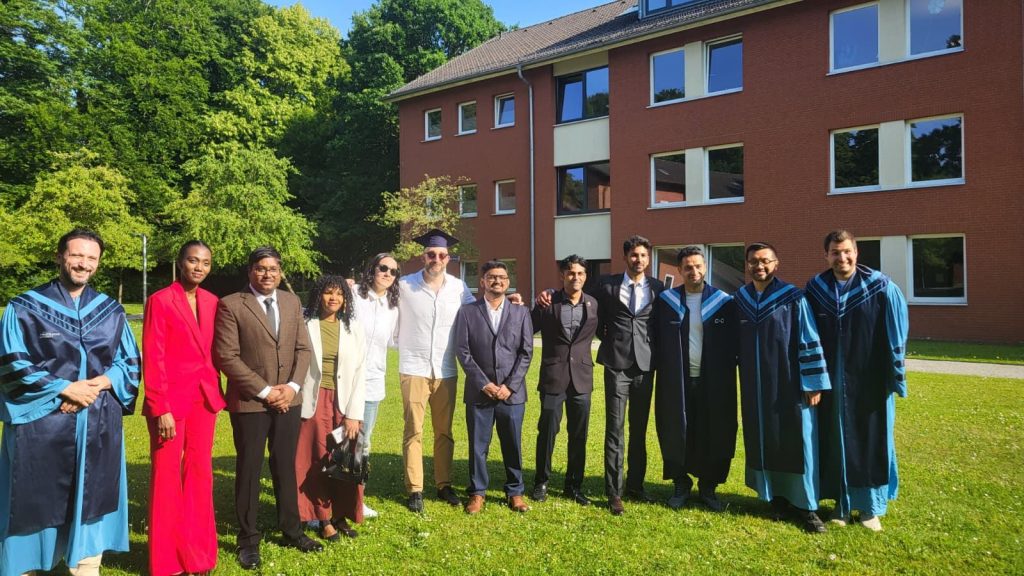
In this new year’s holiday season, the Data-Driven Industrial Systems (DIS) research group pauses to reflect on gratitude.

This year reminded us that meaningful progress is built through consistency, collaboration, and a shared commitment to learning. Some milestones we are thankful for:

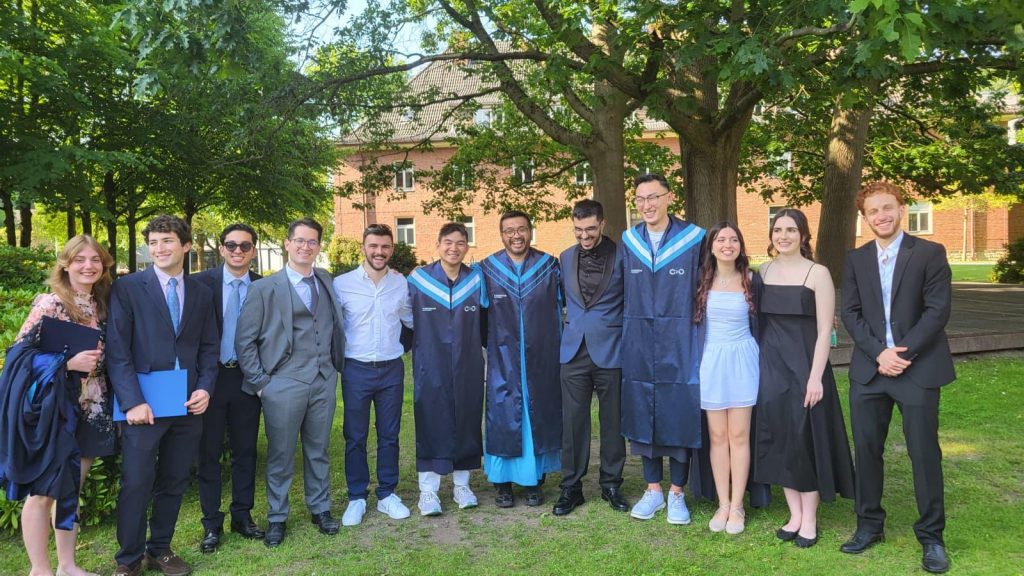
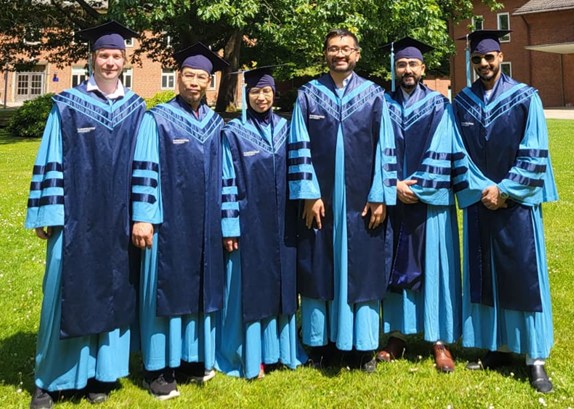
• 5 PhD graduations, 80% completed in under 3.5 years, and each resulting in at least 3 Q1 journal publications

• 25 publications, including 18 Q1 journal articles, with contributions to leading journals such as Journal of Manufacturing Systems (CiteScore 29.4), Sustainable Cities and Society (22.4), Computers in Industry (22.4), Applied Energy (20.1), Resources, Environment and Sustainability (18.5), and International Journal of Production Research (17.5)

• 41 Bachelor’s and Master’s theses successfully completed

• 5 new enrolled PhD students

We are especially proud of the people behind these numbers:

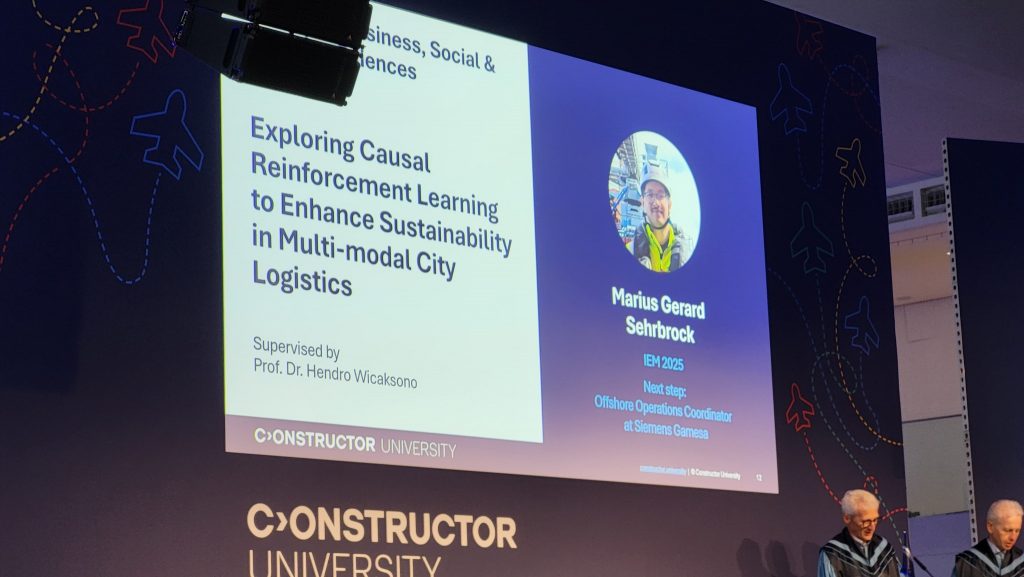
  • Marius Gerhard Sehrbrock (Germany & Philippines), Teaching and Research Assistant, recipient of the Dean’s Prize for Best Bachelor Thesis (School of Business, Social & Decision Sciences)
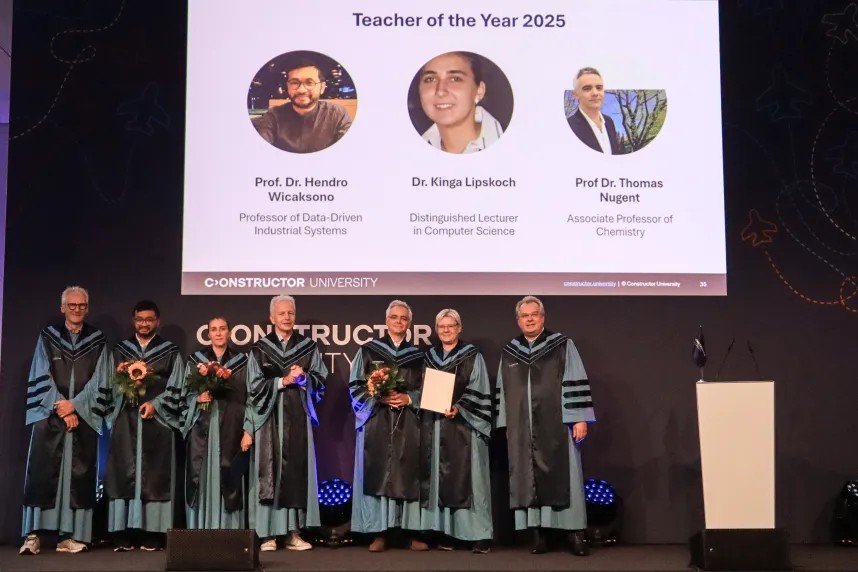
  • Hendro Wicaksono, head of the group, was honored with the Teacher of the Year Award (School of Business, Social & Decision Sciences)
  • Dr. Ishansh Gupta (India), Postdoc, selected to participate in the 8th Lindau Nobel Meeting in Economic Sciences (August 2025)
  • Dario Shandro (Albania) and Alexis Zaidman (Venezuela), Teaching and Research Assistants, were awarded Student of the Year (Industrial Engineering and Management)
  • Nada Martinovic (Serbia), Research Assistant, Faculty Recognition Award (Industrial Engineering and Management)

These achievements belong to a collective (students, supervisors, collaborators, reviewers, and families) who quietly support the journey behind the scenes.

Looking ahead to 2026, we remain grounded and ambitious, aiming for greater impact, stronger interdisciplinary collaboration, and research that not only advances science but also serves society responsibly.

Grateful for how far we’ve come. Energized for how much more we can learn and improve together.
Groundbreaking Study Reveals Strategies for Effective Industry 4.0 Implementation

Our new study published in the Journal of Manufacturing Technology Management offers groundbreaking insights to help industries successfully adopt Industry 4.0 technologies. This research is conducted by Linda Angreani and Annas Vijaya, both research associates and Prof. Dr.-Ing. Hendro Wicaksono, from Constructor University. It provides insights on how companies navigate the complexities of integrating advanced technologies such as automation and the Internet of Things (IoT) into their manufacturing processes.

Key Findings:

The study introduces a comprehensive maturity model designed to assess an industry’s readiness to adopt industry 4.0. By aligning this maturity model with well-established reference architecture models (RAMs) such as RAMI4.0, NIST-SME, IMSA, IVRA, and IIRA, companies can develop more effective strategies for implementing these cutting-edge technologies.

One of the significant findings is the identification of varied interpretations of Industry 4.0 maturity models within organizations. The research highlights the critical challenge of aligning these models with established RAMs, which is essential for a successful Industry 4.0 transformation. Additionally, the study reveals that both maturity models and reference architectures often overlook human and cultural aspects, which are vital for effective implementation.

This research is unique as it is the first to explore the alignment between maturity models and reference architecture models, offering valuable insights for companies striving to enhance their Industry 4.0 adoption strategies.

Implications for Industries:

The insights from this study can help industries overcome common obstacles in their Industry 4.0 journey. By utilizing the maturity model and aligning it with RAMs, companies can better understand their readiness and formulate more robust strategies for technology adoption. This approach promises to streamline the transformation process.

For a more detailed understanding of this research, the full paper is available for download here.

https://www.emerald.com/insight/content/doi/10.1108/JMTM-07-2022-0269/full/pdf?title=enhancing-strategy-for-industry-40-implementation-through-maturity-models-and-standard-reference-architectures-alignment

KEHL

Description

Intelligent energy management for households and public buildings by means of a knowledge-based analysis method.

Duration

09/2009 – 10/2010

Funding

BMBF KMU Innovativ

DIALOG

Description

Development, prototypical implementation as well as testing of a methodology – compared to the current industrial practice – significantly faster and more efficient harmonization of the customer and manufacturer perspective in the preliminary contract phase under real industrial conditions.

Duration

09/2009 – 12/2011

Funding

BMBF

WertProNet

Description

Development of a framework for evaluating the economic flexibility of production systems in German SMEs.

Duration

04/2010 – 10/2011

Funding

BMBF KMU-Innovativ

PROIndo

Description

German-Indonesian bilateral cooperation for application-oriented research in the field of decentralized energy management and renewable energy

Duration

04/2012 -12/2013

Funding

BMBF

wEnPro

Description

Development of methods for analyzing, evaluating and improving energy and resource efficiency in manufacturing SMEs. These are to be integrated into a modular toolset and provide, in addition to pure monitoring functions, in particular, knowledge-based evaluation and control functions. The toolset improves the sustainability of resources usage whilst maintaining flexibility in production.

Duration

06/2011- 05/2013

Funding

BMBF KMU-Innovativ

ecoBalance

Description

Knowledge-based control system for machine tools for balanced load distribution and reduction of power peaks in production

Duration

01/2012 – 07/2014

Funding

AIF-ZIM

« Older posts